Come for the temple’s architecture and atmosphere. Do not assume Bulguksa and Seokguram form one short, level walk.
Plan your visit
The temple’s own seasonal entry schedule gives a more useful planning rule than a single year-round closing time. Ordinary heritage admission is free; transport, parking and separately booked experiences are different costs.
| At a glance | Details |
|---|---|
| Address | 385 Bulguk-ro, Gyeongju-si, Gyeongsangbuk-do · 경상북도 경주시 불국로 385 |
| November–January entry | From 09:00; entry closes at 17:00. |
| February & October entry | From 09:00; entry closes at 17:30. |
| March–September entry | From 09:00; entry closes at 18:00. |
| Ordinary admission | Free; the temple removed the heritage admission charge from 4 May 2023. |
| Regular opening | Open year-round; pets are not admitted. |
| Local bus options | The temple lists city buses 10 and 11. Check the correct stop and current service for your starting point. |
Read the architecture before chasing the next photograph
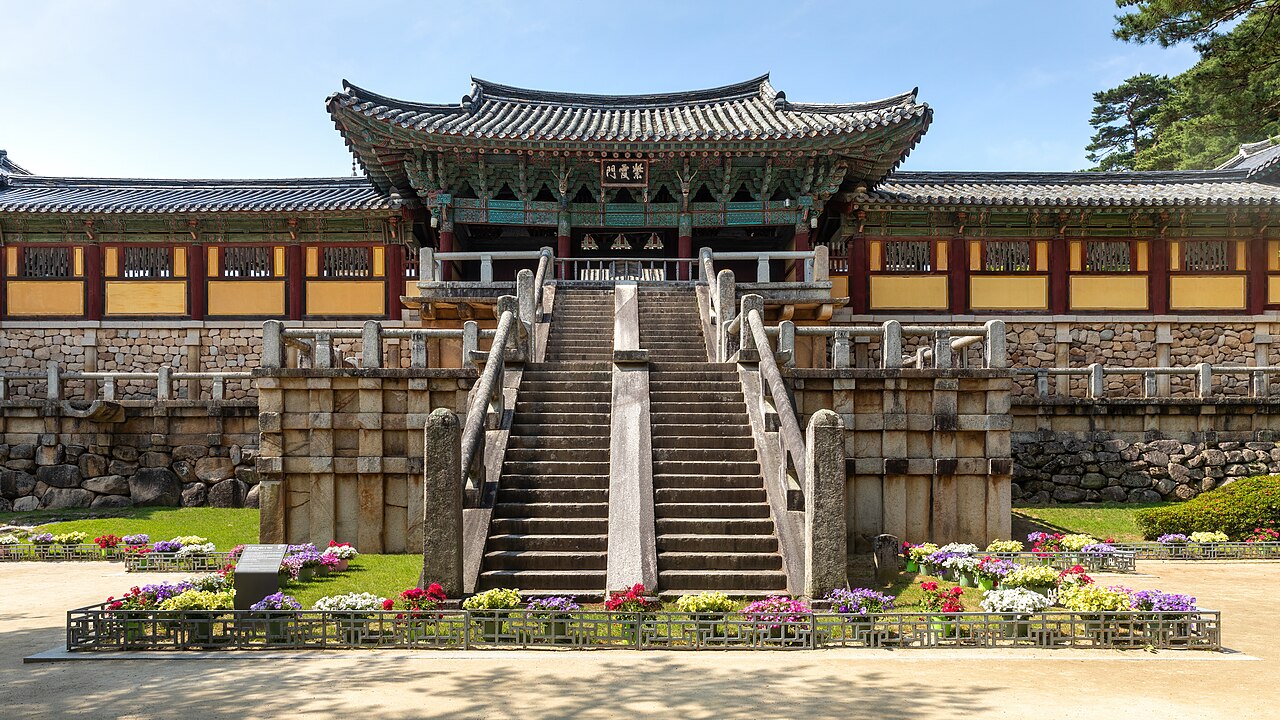
Bulguksa is a UNESCO World Heritage site in Gyeongju, listed together with Seokguram Grotto. Look for the Dabotap Pagoda and the stone stairways of Cheongungyo and Baegungyo as you explore the temple grounds.
Use those stone structures as a reason to slow down. Look at the relationship between stairs, terraces and the wooden buildings, while observing barriers and directions on site. A useful visit can focus on a few architectural details rather than making every corner a photo target.
What to look for in the temple grounds
Bulguksa preserves the Buddhist heritage of the Silla kingdom. Its development includes the rebuilding associated with Kim Dae-seong in 751, later wartime damage and restoration. Read the complex as a place with several historical layers rather than assuming every visible building has stood unchanged since Silla.
The stone terraces and the Cheongungyo and Baegungyo stairways create a striking approach to the halls. Inside the temple area, Dabotap and the three-storey Seokgatap offer contrasting stone-pagoda forms. Look from the permitted visitor areas and follow the marked route rather than climbing historic structures.
A useful viewing sequence is the stone approach, the main courtyard and its pagodas, then quieter temple spaces that are open to visitors. The courtyards can be a place for contemplation as well as photography. Keep worshippers’ access clear and treat an active service as part of the temple’s purpose.
Keep the temple and grotto as distinct visits
Seokguram lies on the hillside of Tohamsan in the official provincial description. Being grouped in a tourism selection does not mean the two places share an entrance, a level path or identical opening arrangements. Check the journey, access and admission for each place you plan to visit.
If time or energy is limited, make Bulguksa the main outing and leave Seokguram for a separate decision. If you choose both, include the transfer and a meal or rest break in your plan. Do not promise yourself a fixed completion time based only on the number of names on a list.
A temple is more than a sightseeing backdrop
Approach the grounds with the awareness that a temple can be a place of religious practice. Keep voices low, follow signs about access and photography and avoid interrupting worship. Do not treat a closed hall or cordoned-off stairway as an invitation to find another way inside.
If you want a guided programme or temple stay, check the specific organiser and dates. An ordinary sightseeing visit does not establish that such a programme is included, available in English or bookable on arrival.
Leave space around the main stop
Plan transport from your actual Gyeongju accommodation or arrival station. Confirm the last part of the journey as well as the intercity journey. If someone needs step-free access, ask about the precise route rather than assuming all areas of a historic site are equally accessible.
Keep a flexible finish: a meal and a return journey may be enough after a careful temple visit. Gyeongju’s other historic sites deserve their own route planning. They should not become a rushed series of extra stops simply because they appear under the same city name.
- Check current entry and visitor information.
- Plan Bulguksa and Seokguram separately.
- Observe worship, photography and access signs.
- Check your return connection before travelling.